
Business
How to Use ChatGPT to Automate Your Small Business in 2026

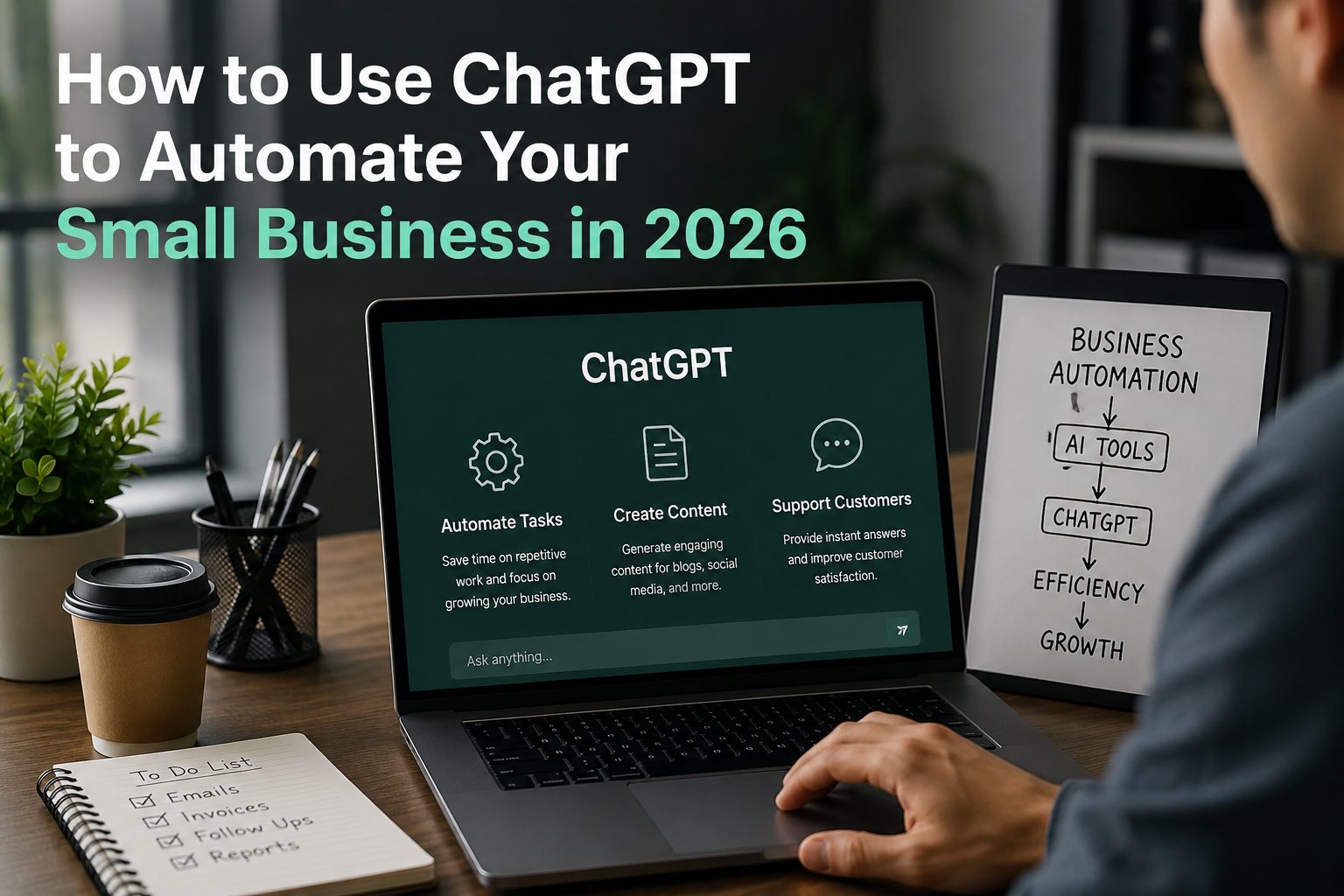
Running a small business has never been easy, but in 2026, business owners have access to tools that previous generations could only dream of. Artificial intelligence is no longer reserved for large corporations with massive budgets. Today, even a small local business can use advanced AI technology to save time, reduce costs, improve customer service, and streamline everyday operations. One of the most powerful tools leading this transformation is ChatGPT.
From handling customer enquiries and creating marketing content to assisting with sales and administrative tasks, ChatGPT is helping businesses work smarter rather than harder. As competition continues to increase across nearly every industry, business owners are looking for ways to achieve more without constantly increasing their workload. This is where ChatGPT for small business automation is making a significant impact.
If you’re wondering how to use ChatGPT for business in 2026, this guide will walk you through the practical ways it can automate daily operations and help your business become more efficient.
Why Small Businesses Are Turning to ChatGPT?
Small business owners often wear multiple hats. On any given day, they may find themselves acting as a marketer, salesperson, customer service representative, content creator, and operations manager. While this level of involvement can help keep costs down, it often limits growth because there are only so many hours in a day.
ChatGPT helps solve this problem by taking over repetitive and time-consuming tasks. Instead of spending hours answering similar customer questions, writing social media captions, drafting emails, or creating content, business owners can use AI to complete these tasks in minutes.
The biggest advantage isn’t necessarily replacing people. Instead, it’s allowing business owners and employees to focus their energy on activities that require creativity, strategy, and relationship building. AI handles the routine work, while humans focus on growing the business.
How ChatGPT Is Changing Business Operations in 2026?
The capabilities of ChatGPT have expanded significantly in recent years. What started as a conversational AI tool has evolved into a powerful virtual assistant capable of supporting multiple areas of a business.
For example, imagine a small digital marketing agency managing several clients. The team spends hours each week creating social media content, responding to enquiries, writing reports, and preparing proposals. With ChatGPT, many of these processes can be completed much faster. Drafts can be generated within seconds, allowing the team to focus on refining and personalising the final output.
The same principle applies to eCommerce stores, local service businesses, consultants, freelancers, and online entrepreneurs. Regardless of the industry, automation helps increase productivity and improve efficiency.
Automating Customer Support With ChatGPT
Customer support is one of the most common areas where businesses benefit from automation. Customers expect fast responses, and delays can often result in lost opportunities.
Many businesses receive the same questions repeatedly. Customers ask about pricing, services, opening hours, delivery times, refunds, or product information. Instead of manually responding to every enquiry, ChatGPT can help generate instant answers and provide support around the clock.
When integrated into a website or messaging platform, ChatGPT can handle common enquiries automatically. This improves response times and creates a better customer experience. Customers receive the information they need quickly, while business owners spend less time managing repetitive conversations.
Although complex situations may still require human involvement, AI can often resolve a large percentage of routine support requests without any intervention.
Creating Marketing Content Faster
Content marketing remains one of the most effective ways to attract customers online. Businesses that consistently publish valuable content often generate more website traffic, improve their search engine rankings, and build stronger relationships with their audience.
However, creating high-quality content requires time and effort. This is where ChatGPT becomes particularly valuable.
Business owners can use ChatGPT to generate blog post ideas, create article outlines, write social media captions, draft email campaigns, and even assist with video scripts. Instead of staring at a blank page, marketers can start with a well-structured draft and customise it to match their brand voice.
This doesn’t mean publishing AI-generated content without reviewing it. The best results come from combining AI efficiency with human expertise. ChatGPT handles the heavy lifting, while the business owner adds unique insights, experience, and personality.
Improving Social Media Management
Maintaining an active social media presence can feel like a full-time job. Between content planning, writing captions, responding to comments, and generating ideas, many business owners struggle to remain consistent.
ChatGPT can simplify the entire process. It can help generate content calendars, suggest post ideas, write engaging captions, and adapt content for different platforms.
For example, a business owner could ask ChatGPT to create thirty social media post ideas for the next month. Within minutes, they would have enough content inspiration to maintain a consistent posting schedule. This not only saves time but also reduces the stress associated with constantly creating new content.
Using ChatGPT for Email Marketing
Email marketing continues to be one of the highest-performing digital marketing channels. Despite the rise of social media and other communication platforms, email remains an effective way to nurture leads and maintain customer relationships.
ChatGPT can assist with creating welcome sequences, promotional emails, newsletters, follow-up messages, and customer retention campaigns. Instead of spending hours writing individual emails, businesses can quickly generate professional drafts and refine them before sending.
This allows companies to communicate more consistently with their audience while reducing the workload associated with campaign creation.
Streamlining Sales Activities
Sales is another area where AI is creating significant value. Many sales processes involve repetitive communication, research, and documentation.
ChatGPT can help draft sales proposals, write follow-up emails, prepare outreach messages, and even assist with lead qualification questions. This enables sales teams to spend more time building relationships and less time performing administrative tasks.
For small businesses with limited resources, this efficiency can make a substantial difference. Faster communication often leads to quicker responses, better customer engagement, and ultimately more opportunities to generate revenue.
AI Tools to Automate Small Business Tasks Alongside ChatGPT
While ChatGPT is incredibly powerful on its own, combining it with other AI solutions can unlock even greater automation opportunities.
Many businesses use workflow automation platforms to connect different systems and automate routine processes. For example, when a lead submits a contact form, automation software can instantly send the information to a CRM, notify the sales team, and generate a follow-up email.
Design tools powered by AI can help create marketing materials, while productivity platforms can summarise meetings, organise information, and manage projects more efficiently.
When businesses combine ChatGPT with other AI tools to automate small business tasks, they create workflows that reduce manual effort across multiple departments. This allows teams to achieve more without increasing headcount or operational costs.
Best Practices for Using ChatGPT Effectively
While ChatGPT can deliver impressive results, the quality of its output depends largely on the instructions it receives. Businesses that provide detailed prompts generally achieve better outcomes than those using vague requests.
When using ChatGPT, it’s important to clearly define the task, target audience, desired tone, and objective. The more context provided, the more useful the response will be.
It’s also important to review and edit AI-generated content before publishing or sending it to customers. While AI can produce excellent drafts, human oversight ensures accuracy, consistency, and alignment with the brand’s voice.
Businesses that treat ChatGPT as a collaborative assistant rather than a complete replacement for human input often achieve the best results.
The Future of Small Business Automation
The role of AI in business will continue to expand over the coming years. Tasks that currently require manual effort will increasingly become automated, allowing businesses to operate more efficiently and scale more effectively.
Companies that embrace automation today are positioning themselves for long-term success. By reducing repetitive work, improving productivity, and enhancing customer experiences, AI creates opportunities for growth that were previously difficult for smaller businesses to achieve.
As technology continues to evolve, the gap between businesses that adopt AI and those that don’t is likely to become even more noticeable.
Conclusion
Learning how to use ChatGPT for business in 2026 is no longer just a competitive advantage, it’s becoming a practical necessity for many small businesses. Whether you’re looking to improve customer support, create content faster, streamline sales processes, or reduce administrative workload, ChatGPT offers a flexible and cost-effective solution.
The rise of ChatGPT for small business automation is changing how entrepreneurs manage their daily operations. When combined with other AI tools to automate small business tasks, such as agentic AI tools for small businesses, it can help businesses save time, increase efficiency, and focus on what matters most: serving customers and growing sustainably.
For small business owners willing to embrace innovation, ChatGPT represents one of the most accessible and impactful technologies available today.




The year 2026 marks a significant shift in technology, transforming how small businesses operate, expand, and support their clients. The rise of Agentic AI Tools is one of the most interesting changes. These tools are more advanced than regular automation because they can make informed decisions, learn from data, and work independently to complete complex tasks. They work great for small businesses that need to get more done with less money and time.
Agentic AI platforms help small businesses boost efficiency and stay competitive by automating tasks such as customer service, inventory management, and marketing. Technologists use the term “Autonomous AI tools” to describe systems that think, plan, and act with little help from a person. AI workflow automation tools driven by agentic models are very useful for entrepreneurs and startups because they save time and make tasks easier. This article discusses five of the best Agentic AI Tools for small businesses in 2026. It will also show you how these systems can change the way you do your job.
TaskMind – The Ultimate Workflow Optimizer
TaskMind is the leader in AI workflow automation, designed specifically for small teams and solopreneurs. Smart algorithms enable this powerful agentic AI tool to plan, assign, and execute tasks across departments. It learns from how people use it and suggests more effective ways to perform everyday tasks. TaskMind automates the entire process while still allowing you to stay in control, whether you’re managing inventory, handling invoices, or scheduling meetings.
It doesn’t just follow rules like older software did; it changes and thinks like a smart helper. TaskMind integrates seamlessly with many common business software applications, including Slack, Trello, and QuickBooks. It is one of the most useful and agentic AI platforms. Less work needs to be done repeatedly, allowing teams to focus on the most important tasks. TaskMind is a good choice if you want to save time and get better results without adding more people. It’s ideal for companies that want smart tools to handle the hard work without constant supervision.
BrandGenie – Autonomous AI for Content and Marketing
Marketing can be time-consuming, but BrandGenie offers a complete solution using Autonomous AI tools. This agentic AI platform plans campaigns, writes emails, creates social media posts, and even develops marketing strategies without needing constant monitoring. It understands the company’s tone, what the audience likes, and the marketing goals. It learns what works best over time and adjusts its methods accordingly. BrandGenie also provides you with information about how your projects are performing, so you can identify what’s working and make adjustments right away.
A small business that doesn’t have a full-time marketing team but still wants to look professional and be busy online should use it. As one of the most advanced Agentic AI Tools, BrandGenie makes AI marketing feel human. It makes AI marketing feel like a person does it. You have more time to run your business because it takes care of the creative and technical chores. BrandGenie’s self-planning feature gives you a significant advantage, whether you’re launching a new product or trying to boost engagement with your brand.
AutoServe – Smart Customer Support Without the Overhead
Small businesses often struggle with providing effective customer service. AutoServe changes the game by giving your customer interactions autonomous AI tools. This agentic AI tool handles questions, returns, follow-ups, and cases that require escalation—all without the need for a full team. It acts like a person talking to you and learns from each exchange to give you better help next time. AutoServe isn’t like other chatbots because it connects to your CRM and support tools.
It anticipates what customers want and helps them avoid problems before they arise. For instance, it can identify trends in complaints and notify business owners of persistent issues. AutoServe is one of the most reliable agentic AI platforms on the market today because it can smartly solve problems. AutoServe is a good investment if you want to keep customers happy without incurring additional expenses. Customers will be pleased with the high-quality assistance you can provide 24/7, and your employees will have more time to focus on other tasks.
FinPilot – Financial Automation with Decision-Making Power
One of the most time-consuming aspects of running a small business is managing finances. FinPilot makes things easier by using Agentic AI Tools that help with more than just accounts. It can analyze your cash flow, identify unnecessary spending, send you bill reminders, and even suggest investments that are best suited for your business. Based on real-time data, this agentic AI tool determines how to manage money. It also keeps up with tax laws and notifies you about any upcoming changes or deadlines.
With AI workflow automation at its core, FinPilot ensures that financial tasks like budgeting, invoicing, and forecasting are handled without errors or delays. It ensures that financial tasks such as budgeting, billing, and forecasting are completed accurately and efficiently, without errors or delays. FinPilot is the best way for businesses to manage their finances without hiring a full-time accountant, as it seamlessly integrates with banking systems. FinPilot gives you better control over your money and a better understanding of your business’s finances, all in one safe and simple package.
HireBotics – Smarter Hiring and HR Automation
Due to a lack of funding, small businesses often have trouble hiring people and managing HR. That changes with HireBotics’ Agentic AI Tools, which are made for hiring, onboarding, and handling employees. This AI tool can write job descriptions, screen applicants, schedule interviews, and even provide feedback tailored to the role’s needs. HireBotics doesn’t just use keywords; it also employs deep learning to assess factors such as cultural fit, long-term potential, and soft skills.
It also automatically conducts performance reviews and tracks employee satisfaction, ensuring they are both happy and productive at work. If you want to have an HR department in your pocket, HireBotics is the best agentic AI platforms. HireBotics accelerates the hiring process and enhances the quality of the candidates selected by leveraging AI workflow automation. It saves time and reduces paperwork while helping small businesses hire more effectively. HireBotics will still be useful after 2026 if you want to add people to your team without adding to your stress.
Conclusion
From 2026 on, small businesses that want to stay ahead will need to use Agentic AI Tools. These tools do more than just automate chores; they also help people think critically, act independently, and continue learning. The way business is conducted is changing due to agentic AI platforms like TaskMind, BrandGenie, AutoServe, FinPilot, and HireBotics. These platforms help you manage your team and funds, find new customers, and provide excellent customer service. Small businesses can work smarter, not harder, when they utilize Autonomous AI tools.
These technologies are leveling the playing field, allowing even small businesses to compete effectively with larger ones. With built-in AI workflow automation, they reduce errors, boost efficiency, and free up time to focus on strategy and growth. These Agentic AI tools are ready to help you make your business smarter. The future is now, and it’s smart, useful, and made just for you. AI can help your small business grow in 2026.

Ethereum has been one of the most influential cryptocurrencies since its launch in 2015. It gained immense popularity among developers and investors due to its smart contracts and decentralized applications. On the other hand, Ethereum has undergone significant changes over the years. With Ethereum 2.0, one of the most significant changes was the transition from Proof of Work (PoW) to Proof of Stake (PoS). The goal of this change was to make the network more scalable and use less energy.
Now that it’s 2026, many people want to know: Can you still mine Ethereum? The answer may not be as clear now that the Ethereum blockchain no longer relies on standard mining. This blog will discuss the current state of Ethereum, the impact of the switch to staking, and what options are available to those who previously mined ETH. Here is everything you need to know about Ethereum in the year 2026, including whether mining is still an important part of its environment.
The End of Proof of Work for Ethereum
With an update called “The Merge” in September 2022, Ethereum’s mining process came to an end. Proof of Work (PoW) was replaced by Proof of Stake (PoS) with this significant change. Miners used very fast computers to figure out hard problems and get rewards in the PoW model. PoW, on the other hand, consumed a significant amount of energy and generated environmental problems. That’s why the people who work on Ethereum switched.
Ethereum no longer needs miners because of PoS. Instead, validators risk ETH to keep the network safe. Randomly selecting these validators to verify deals and add new blocks is how they perform their job. As a result, GPUs and ASICs, which were once used for mining, are no longer suitable for Ethereum. Now that it’s 2026, the answer is clear: you can’t mine Ethereum the old way anymore.
Ethereum Staking: The New Way to Earn ETH
Although you can no longer mine Ethereum, you can still stake to support the network. This is what Proof of Stake is all about. You need to deposit 32 ETH to become a validator. You can earn reward points for verifying deals. This method is easier to access and uses less energy than mining.
Don’t worry if you don’t have 32 ETH. You may join a pool for stakes. With these pools, money from multiple users is combined to reach the required amount. Then, the prizes are divided based on the amount each person contributed. As of 2026, staking is the standard way to help the Ethereum network and make money without doing anything. Mining is over, and holding is the new thing to do. For the blockchain’s long-term health, it’s also safer and more flexible.
What Happened to Ethereum Miners?
Miners had to decide what to do after Ethereum moved to Proof of Stake. Their pricey mining gear was no longer useful for Ethereum. Other miners transitioned to mining other cryptocurrencies, such as Ergo (ERG), Ravencoin (RVN), or Ethereum Classic (ETC). Some miners sold their hardware. Proof of Work is still used for these coins, and GPU mining is still possible. However, these options don’t generate as much revenue or remain as stable as Ethereum has.
Many miners lost money because the rewards were low and the cost of power was high. Others utilized their powerful GPUs to expand into new areas, such as cloud computing or AI processing. In 2026, most people who previously mined Ethereum have either transitioned to other jobs or ceased working in the field altogether. The end of ETH mining marked the end of a chapter, but it also prompted people to think of new ways to utilize their hardware and skills.
Can You Still Mine Any Form of Ethereum in 2026?
Forks and other networks, like Ethereum, that use Proof of Work are still in existence in 2026, but Ethereum itself can’t be mined. One example is Ethereum Classic (ETC), which is the first form of Ethereum before it split in two in 2016. Mining is still possible on Ethereum, and its community is very loyal. You could also try alternatives like “ETHPoW,” a fork that kept the PoW model after the Merge.
However, these networks are typically smaller and generate less revenue. Not as many people want them, and they’re not worth as much as ETH. To ensure that mining them is worth the cost of energy and hardware upkeep, you need to perform extensive calculations. In short, you can no longer mine the main Ethereum (ETH) system. You can only mine coins that resemble Ethereum or originate from it. Before you put your time or money into a mining project in 2026, you should know the difference.
Should You Invest in Ethereum in 2026?
In 2026, Ethereum remains a viable investment option, despite the fact that mining is no longer feasible. Many autonomous apps, NFTs, and smart contracts run on it. In the world of DeFi (Decentralized Finance), Ethereum is also the leader. The network functions more efficiently now that Proof of Stake is in use, and gas fees have decreased. This makes it easier to get more people and developers.
Staking is a new way to get benefits, and Ethereum is always adding new features. ETH investors can generate profits from network growth, staking, and the coin’s value appreciation over time. If you don’t want to stake directly, you can use ETFs or crypto sites that offer staking services with fewer restrictions. So, Ethereum is still a useful asset even if you don’t mine it. It remains the leader in crypto, boasting strong growth and practical applications in the real world.
Conclusion
Since the early days of mining and the Proof-of-Work consensus system, Ethereum has come a long way. The network has entered a new era with the successful launch of Ethereum 2.0 and its transition to Proof of Stake. In 2026, you won’t be able to mine Ethereum the way you used to. Powerful tools once solved puzzles, but that process is no longer used. But that doesn’t make Ethereum less interesting.
It is bigger, faster, and uses less energy now than it did before. Staking has replaced mining, giving users new ways to earn benefits and support the network’s operation. “Can you still mine Ethereum in 2026?” This is the question that people ask. The answer is no, at least not the Ethereum that most people are familiar with. You can still have a say in its future, though, by buying or staking. Ethereum remains the leader in cryptocurrency, and its evolution has paved the way for other blockchains to follow suit in the years to come.

A lot has changed in the world of cryptocurrencies since 2025. In the past, crypto mining was seen as a gold rush for tech-savvy buyers. However, things have changed significantly in the last few years. Many people are wondering if crypto mining remains worthwhile in 2025, given the rising cost of energy, stricter regulations, and the growing popularity of proof-of-stake systems.
This blog will explain what cryptocurrency mining is, how it has evolved, and whether it remains a viable means of earning money today.
We’ll discuss the pros and cons, costs, and dangers that miners face. We’ll also discuss how new coins and tools are transforming the mining world. This article provides a clear account of the current state of mining, whether you’re a beginner looking to learn more or an experienced investor seeking to stay up to date. Let’s examine what crypto mining is really like in 2025 and determine if it’s still a viable option or a thing of the past.
What Is Crypto Mining and How Does It Work?
Crypto mining verifies that transactions in cryptocurrencies on a blockchain network are genuine. Miners use extremely powerful computers to solve complex mathematical tasks. By adding transactions to the blockchain, these systems confirm and protect them. Miners receive payment in cryptocurrency, typically in the form of the coin whose validity they helped establish. Proof-of-work (PoW) networks, such as Bitcoin, remain the primary location for mining in 2025. Ethereum, on the other hand, has transitioned to proof-of-stake (PoS), which alters the process of verifying transactions.
For Proof of Work (PoW) mining to work, you need special tools and a lot of power. How well mining goes depends on the availability of processing power, the cost of electricity, and the difficulty of the mining. Understanding the technical aspects of mining helps buyers determine if it’s a good investment opportunity. Mining has become increasingly competitive as concerns about the environment have grown, necessitating the need for more powerful equipment. Still, mining can be a good way to make money if you have the right equipment and the cost of electricity is low. This is especially true in places where energy is cheap.
The Rising Cost of Mining Equipment and Power
In 2025, the high cost of power and tools is a primary concern for miners. ASIC (Application-Specific Integrated Circuit) machines are expensive and require frequent updates to stay competitive. They are made to mine efficiently. A top-of-the-line ASIC miner can be expensive and will likely become outdated in a few years. Electricity remains the largest fixed cost. Mining rigs consume a substantial amount of power and remain in constant operation. When power costs a lot, businesses quickly lose money.
Some mines are moving to places like Iceland or parts of South America where energy is cheaper and cleaner. Some governments are also raising taxes or making it more difficult for large mining companies to obtain power. It costs more and makes things less certain. Breaking even can take months or even years if miners cannot obtain affordable hardware and energy. This makes it a dangerous investment for people who only mine occasionally.
Shift Toward Sustainable and Green Mining
As the world’s focus shifts to sustainability, cryptocurrency mining is being encouraged to have a reduced environmental impact. Many projects are moving toward more efficient ways of doing things in 2025. Renewable energy sources, such as wind, sun, and water, are being increasingly used to power mine farms. Over time, these methods not only cut costs but also make people less critical of crypto’s carbon footprint. Green mining is now more necessary than it was a trend.
Green mines have found it easier to operate in places like Canada and Norway, which offer tax incentives and access to cleaner energy sources. Some companies even advertise themselves as eco-friendly mines to attract investors. There are also improvements in chip efficiency and cooling systems that help reduce energy use overall. Making the switch to green mining requires an initial investment, but it helps ensure long-term sustainability and aligns with environmental goals. When rules become stricter, miners who fail to adapt may be forced out of the market.
Proof of Stake vs. Proof of Work: The Big Debate
This marks a significant shift in the world of cryptocurrencies in 2025: the ongoing debate between proof-of-stake (PoS) and proof-of-work (PoW) systems. Bitcoin utilizes the Proof of Work algorithm, which requires miners to solve complex puzzles to verify transactions. PoS, on the other hand, lets people back up deals with the coins they own and are willing to “stake.” Since Ethereum transitioned to Proof of Stake, many new coins have followed suit. PoS is thought to be more flexible and uses less energy. Because of this change, many coins don’t need to be mined in the usual way as often.
However, Bitcoin, the most popular cryptocurrency, still employs PoW, which means that mining remains important. Potential workers should be aware of this change. As more coins switch to PoS, there are fewer chances to make money by mining PoW coins. Newbies must decide whether to mine Proof-of-Work (PoW) coins, stake Proof-of-Stake (PoS) coins, or spend in other ways related to cryptocurrencies, such as yield farming or node operation. What you should do depends on your budget, goals, and technical skills.
Is Mining Still Profitable in 2025?
Do people still want to mine in 2025? That’s the big question. It’s not easy to say. Mining isn’t as appealing as it once was for casual individuals who lack substantial resources. Small or negative returns can occur due to factors such as high start-up costs, power bills, and market volatility. Some small mines might lose all their money. However, mining is still profitable for larger businesses that have access to cheap power and the latest tools. Industrial mining farms continue to generate revenue, particularly since the price of cryptocurrencies like Bitcoin remains high.
Mining pools also lower risk by allowing individuals to collaborate and share the benefits. Now, planning and scale are more important than ever in mining. No longer is it enough to just plug in a machine and wait for the money to come in. To successfully pursue mining in 2025, you should conduct extensive research. Consider all the risks and associated costs. Many people may achieve better returns with less effort if they stake or trade directly in coins.
Conclusion
Crypto mining isn’t the same as it used to be in 2025. The field has evolved, now shaped by stricter regulations, environmental concerns, and increased business costs. Mining is still mostly about validating deals in exchange for rewards, but the game is now much more difficult and competitive. In the right situations, mining can still be a viable way to generate income. To be successful now, you need to have access to affordable, renewable energy, high-tech mining equipment, and a deep understanding of the market.
It’s possible that mining may no longer be the best way for new crypto enthusiasts to get started. Other options, such as investing, staking, or participating in decentralized finance (DeFi), may yield better results with lower risk. To sum up, cryptocurrency mining is still thriving, but it’s no longer the easy money machine it once was. Carefully consider your goals, resources, and risk tolerance before making a decision. In 2025, mining will pay off for people who work smart, not just hard.
-
 Business2 years ago
Digital Marketing for Doctors: Effective Strategies for Medical Marketing
-
 Business2 years ago
How to Start and Grow a Digital Marketing Agency in 2025
-
 Business2 years ago
Best SEO Tools for Small Businesses: A Beginner’s Guide
-
 Business2 years ago
The Ultimate Guide to Amazon Advertising: Mastering Amazon Ads for Success
-
 Business2 years ago
Best Guide to SEO Companies for Small Businesses
-
 Crypto1 year ago
Top Altcoins Outperforming Bitcoin in 2025
-

 Business12 months ago
How to Buy Trump Coin in 2025: Step-by-Step Guide + Price Prediction Insights
-

 Technology11 months ago
Introduction to Python for Data Analysis